Understanding Tinnitus
What the sound really is, what causes it, and why it isn't the sign of something sinister. Includes the reassurance chapter most people never get.
You've been told there's no cure, so there's nothing to be done. That's only half true. There may be no switch that turns tinnitus off — but there is a well-evidenced path to the point where it stops controlling your sleep, your focus and your mood. This book walks you down that path, step by step.
This is what living with tinnitus actually looks like day to day — the part that rarely gets discussed. If you're nodding along to three or more of these, this book was written for you.
Your distress and your tinnitus are two different things — and they can be separated.
The sound is generated by your auditory system. But how loud it feels, how often you notice it, and how much it hurts are governed by something else entirely: the alarm response your brain has attached to it. Your brain has flagged that sound as a threat, and threats get monitored constantly.
That flag can be lowered. The process is called habituation, it is well documented, and it is the reason most people with tinnitus go hours — then days — without noticing it at all. It isn't wishful thinking and it isn't a cure. It's a skill, built deliberately, using the same strategies audiologists use in clinic.
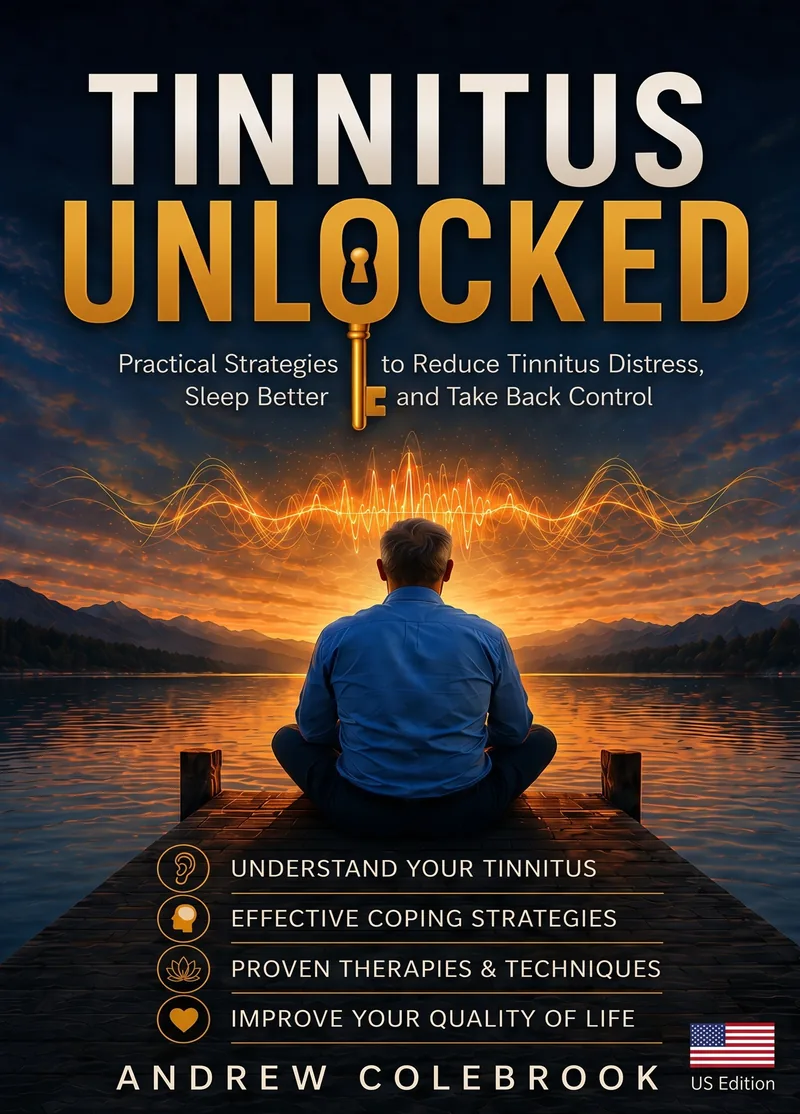
Tinnitus UNLOCKED is the complete, plain-English version of that clinical toolkit — the one you'd get across a dozen appointments you'd otherwise wait months for.
A complete tinnitus management toolkit across eleven chapters, in the order you actually need them — from "what is this?" to "I barely notice it anymore."
What the sound really is, what causes it, and why it isn't the sign of something sinister. Includes the reassurance chapter most people never get.
Clear red flags and timescales — emergency, urgent, routine — plus exactly what to say and ask at your appointment so you're taken seriously.
Emotions, relationships, work and study. How to explain an invisible condition, and the workplace adjustments you're entitled to ask for.
The chapter most readers turn to first. Bedside sound, the 20-minute rule, relaxation techniques, and how to break the anxiety–sleep–tinnitus cycle.
Safe listening levels, which hearing protection to use where, headphone habits — and how to do it without hiding from life in silence.
The stress–tinnitus connection, cognitive techniques for catastrophic thinking, acceptance-based approaches, and when to get professional support.
Why hearing aids help tinnitus so often, what tinnitus-feature devices do, how to get fitted, and what to realistically expect.
Sound enrichment done properly — which sounds, at what volume, through what device, and how to build a home and workspace that works with you.
An honest look at diet, exercise, caffeine, alcohol and nicotine — what the evidence supports, and what's marketing.
Habituation in practice: what it feels like, how to handle setbacks and spikes, and how to build a life that isn't organized around a sound.
Vetted organizations, helplines, specialist clinics, apps, communities and further reading — so you always know where to turn next.
The Kindle edition is on your phone in under a minute.
Not silence. Something better, and genuinely achievable — this is the destination the book is built around.
Habituation and effective management make this achievable for most people. It takes consistency, not luck.

No — and be cautious of anything that claims it will. There is currently no universal cure for tinnitus. What this book gives you is the full set of evidence-based strategies that reduce how intrusive and how distressing tinnitus is, which for most people is the change that actually gives them their life back.
No. Habituation isn't limited to new cases. Plenty of long-standing sufferers have simply never been given a structured approach — they've been coping alone, often while unknowingly doing things that reinforce the alarm response. Chapters 6 and 10 are written with exactly this reader in mind.
The strategies are identical. The difference is the practical guidance: the US edition refers to doctors, audiologists, ER care and US organizations; the UK edition covers NHS referral pathways, GP and audiology appointments, 999/A&E and UK charities and helplines. Choose whichever matches where you'll seek care — you'll pick your edition on the next screen when you click to buy.
No. It's built as a reference as much as a read-through. If sleep is your worst problem, start at Chapter 4 tonight. If fear is the worst part, start at Chapters 1 and 2. Each chapter stands on its own and ends with concrete action steps.
It's written in plain English for people with no clinical background. Where something technical matters — how the brain generates the sound, how hearing aids help — it's explained with everyday analogies rather than jargon.
Kindle if you want to start tonight, and because you can adjust text size and read in bed without a lamp. Paperback if you'd rather annotate it, keep it on the bedside table, or pass it to a family member who wants to understand what you're dealing with. Many readers end up with both.
Absolutely not, and the book is emphatic about this. Chapter 2 exists precisely to get you assessed properly and to help you recognize the symptoms that need urgent attention. Think of this as the guide that makes your appointments more useful — not a replacement for them.
You've already spent more hours lying awake with this than it will take to read the book. Chapter 4 alone could change how tonight goes.
The strategies are the same in both. The difference is the healthcare guidance — pick the one that matches where you'll seek care.
Prices and availability are set by Amazon and TikTok Shop and may vary by region.